I think, therefore I drink.


Words to live by... (BeertopiaHK)

Words to live by… (BeertopiaHK)

I recently attended the Beertopia event with 400+ beers available to taste. It got me thinking of the merits of beer and my mentoring professor whose motherland is the emerald isle. He always professed (pun-intended and I paraphrase)”…the Irish are hardy people, we survived on beer. How else do you think we got through the famine?

There are many health benefits attributed to wine, the anti-oxidant factor called resveratrol, is the most studied wine compound with definite links with heart health (1). Although, realistically, the amount in 1 glass of wine do not equate to the amount of the phytochemical compound used in studies that show benefits. The health connection may not be so farfetched due to the main ingredient in wine: grapes. For beer, the main ingredients is water with a bit of fermented plants-barley and hops-for “flavor”. Overall, there may be more nutrients* in beer when compared to wine. *Vitamin B family complex, proanthocyanidin. However, BOTH wine and beer have more micronutrients than the average person would think such as calcium or magnesium. Below is a brief summary from the handy Google tool for nutrient comparison, just type in the search “x compare to y” or in this case “red wine vs beer”. I did compare the data to the standard USDA Nutrient Lab Database and they were similar enough for a rough eyeball comparison, but not to used for exact calculations in research.
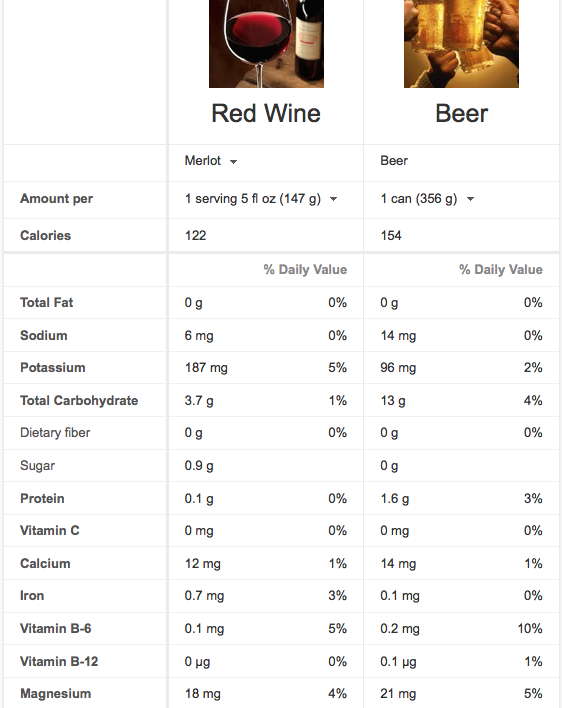
Google Tool nutrient comparison between red wine and beer.

Google Tool nutrient comparison between red wine and beer.

What is a “drink”? (defined by USDA)

  • 12 oz beer
  • 5 oz wine
  • 1.5 oz spirit

The recommendation is 1 drink/day for women; 2 drinks/day for men. Interestingly, I looked at the France’s Manger Bouger, the equivalent to the USDA’s MyPlate (2) since the culture of food and eating is very different from a typical American.

France's drink recommendation

France’s drink recommendation

Their recommendation is: 2 glasses/day for women; 3 glasses/day for men.(3) Just a little bit different than USDA’s recommendations.

References:

Giancoli A., A Toast to Good Health ADA Times Winter 2011.

1.http://www.mayoclinic.org/diseases-conditions/heart-disease/in-depth/red-wine/art-20048281

2. http://www.choosemyplate.gov

3. http://www.mangerbouger.fr/bien-manger/que-veut-dire-bien-manger-127/les-9-reperes/eau-a-volonte-pendant-et-entre-les-repas.html

© Charlene C Ho and its a NUTTY, NUTTYgrrl world…blog, 2010. Unauthorized use and/or duplication of this material without express and written permission from this blog’s author and/or owner is strictly prohibited. Excerpts and links may be used, provided that full and clear credit is given to Charlene C Ho and its a NUTTY, NUTTYgrrl world…blog with appropriate and specific direction to the original content.

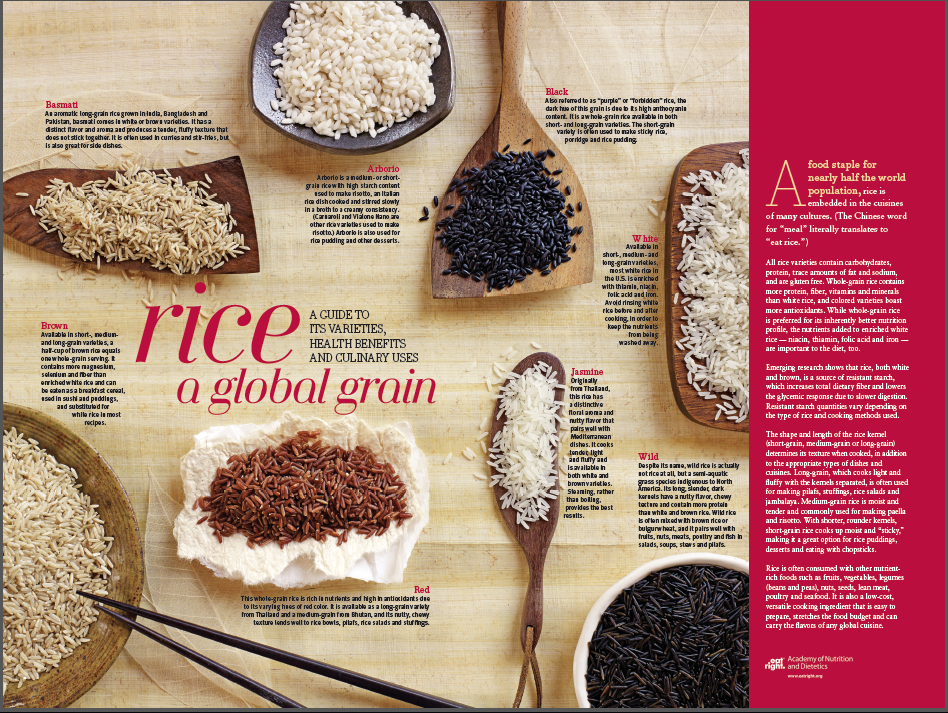


All rice are created equal

Therefore they should be treated as such, right?

Types of rice courtesy of eatright.org

Types of rice courtesy of eatright.org

There are different types of rice: white -arborio, jasmine, basmati-, brown, red, and the minorities of (black) wild rice. However, they CANNOT be treated the same when speaking of health.

According to the USDA National Nutrient Database (1), the macro-, micro- nutrient content can vary. Below, is a very brief overview of some of the key nutrient values of certain types of rice.

Type of rice 1cup size (g) Carbs (g) DietaryFiber (g) Iron (mg)
Wild 164 35 3 0.9
White –med 186 53 0.6 2.7
Brown –med 195 46 3.5 1.0
White – short 186 53 0 2.7

Notice the differences in the amount of dietary fiber (DF) or iron. Just think how that effects the digestion and subsequent utilization in our body and overall health. Also, think about the serving size, one cup, but the actual amount of weight for each type of rice differs. Even though one cup of brown rice has the greatest amount in weight (195 g) and may have the least content of iron, its got the greatest DF. This means that brown rice when eaten will provide more bulk while taking a little longer to digest/absorb into the body. This reflects in how quickly (or shall I say slowly) energy is released into circulation. The feeling of satiety and energy will be prolonged. However, to provide a balanced diet of vitamins and minerals, do include other sources of iron with the meal of brown rice. Afterall, eating a rainbow of colours is ideal for any meal.

For an alternative grain, that may provide something exciting for the taste buds or a challenge in the kitchen, try quinoa (keen-wah) or couscous and barley. These are considered to be whole grain -not refined or processed like white rice- that not only adds bulk to your meal, but hidden nutrients and DF from the outer skin that are normally processed/washed off for better marketing and consumption by the public.

I always joke about how some cultures only exist on a diet of “brown and white” foods (in reference to my fish supper eating sweatheart) and though it is delicious and not all processed and packaged foods, I think the colour of brown can be beneficial when its in the form of rice or quinoa or barley…. take your pick!

Reference:

1. http://ndb.nal.usda.gov/

© Charlene C Ho and its a NUTTY, NUTTYgrrl world…blog, 2010. Unauthorized use and/or duplication of this material without express and written permission from this blog’s author and/or owner is strictly prohibited. Excerpts and links may be used, provided that full and clear credit is given to Charlene C Ho and its a NUTTY, NUTTYgrrl world…blog with appropriate and specific direction to the original content.